Enterprise deployments available now · SaaS in public beta

From requirement to verified product. Evidence included.

ROPARC is the lifecycle platform for safety-critical product development. Specify, design, review, verify and prove in one workarea, with the traceability intact at every step and the audit trail already written when the assessor arrives.

On-prem and dedicated deployments are available today. Prefer the cloud? Join the public SaaS beta, free while it runs.

Requirements that remember everything

One workarea for the whole V

Most tools cover one leg of the lifecycle and hand the rest to spreadsheets. ROPARC carries a requirement from the first draft through design, review and test to the evidence an assessor will accept.

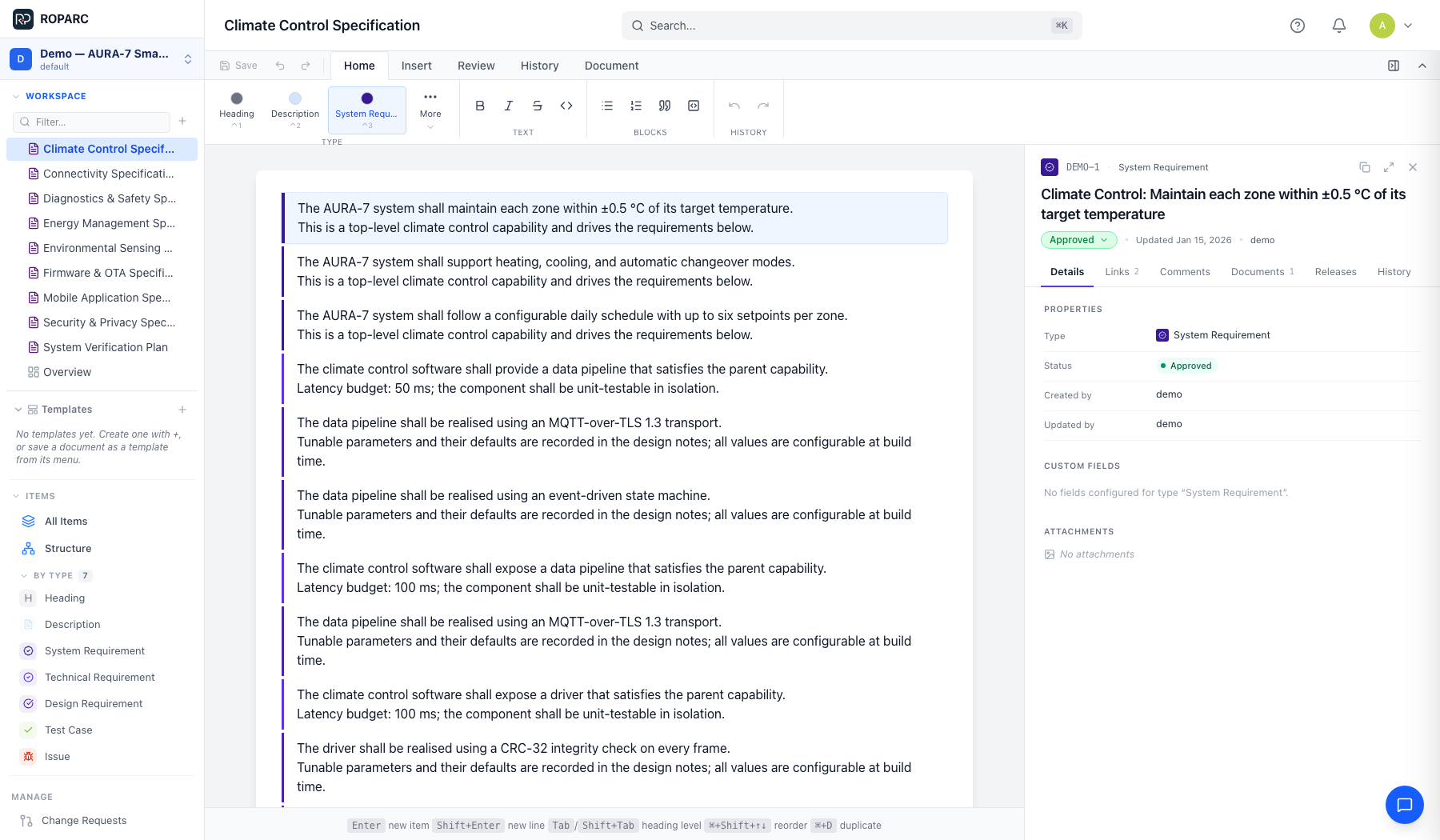
The document editor showing the Climate Control Specification with a system requirement selected and its details panel open on the right.
01 · Specify

Write the specification, not a spreadsheet.

Author requirements as structured, auto-numbered documents with every item embedded where it belongs. Links, attributes and history sit one panel away. Bring in what you already have: a PDF or Word specification through rule-based import, or a DOORS or Polarion export through ReqIF.

  • Structured documents with embedded work items
  • PDF and Word import with rules you control
  • ReqIF and Excel import for migration
Learn more
DESIGNBC · Boom Control Speed sensor System element Controller System element Hydraulic pump System element Pressure signal interface · CAN realizes · REQ-42 · Approved verified by · TC-118
02 · Design

Design the system against the requirements.

Model functional, logical and design architecture with interfaces and ports. Every element is a work item in the same workarea, so the architecture is traced to the requirements it realises and the tests that verify it, not kept in a separate modelling tool. Add fault trees for the safety case.

  • Functional, logical and design views
  • Interfaces and ports as first-class items
  • Fault trees linked to the hazards they analyse

With Solution Flow Composer, available on request.

Learn more
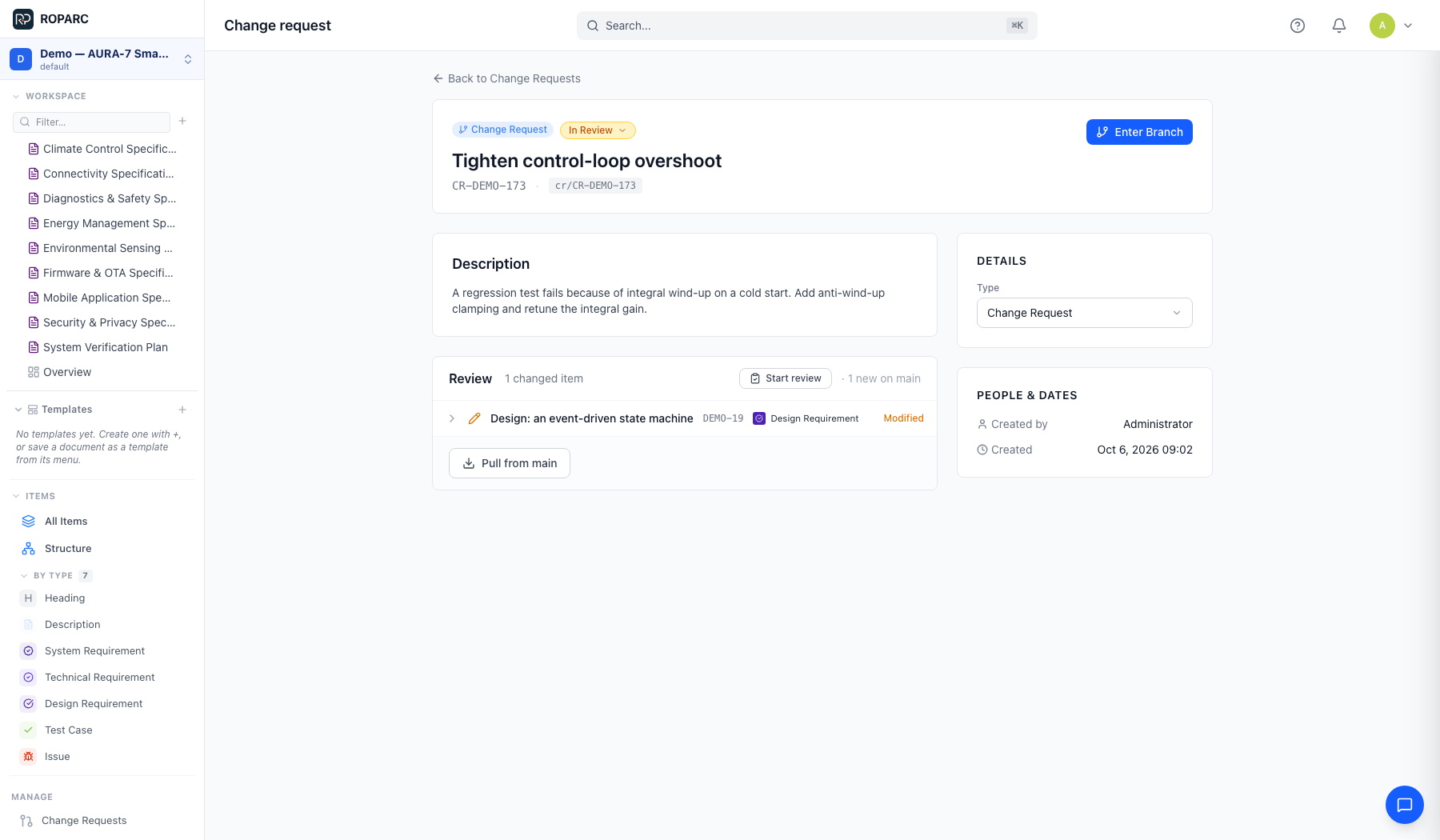
A change request "Tighten control-loop overshoot" in review, listing one modified design requirement and offering Enter Branch, Start review and Pull from main.
03 · Review and change

Change under control, reviewed in context.

Propose a change on its own branch, not in a side-channel ticket. Reviewers see the complete diff of every affected item before anything lands, and approval runs through a workflow with guards you define. Formal document reviews happen inside the document, with named participants, checklists and a verdict on every item.

  • Change requests as isolated branches with a full diff
  • Formal reviews with participants and checklists
  • Workflows with guards that block invalid moves
Learn more
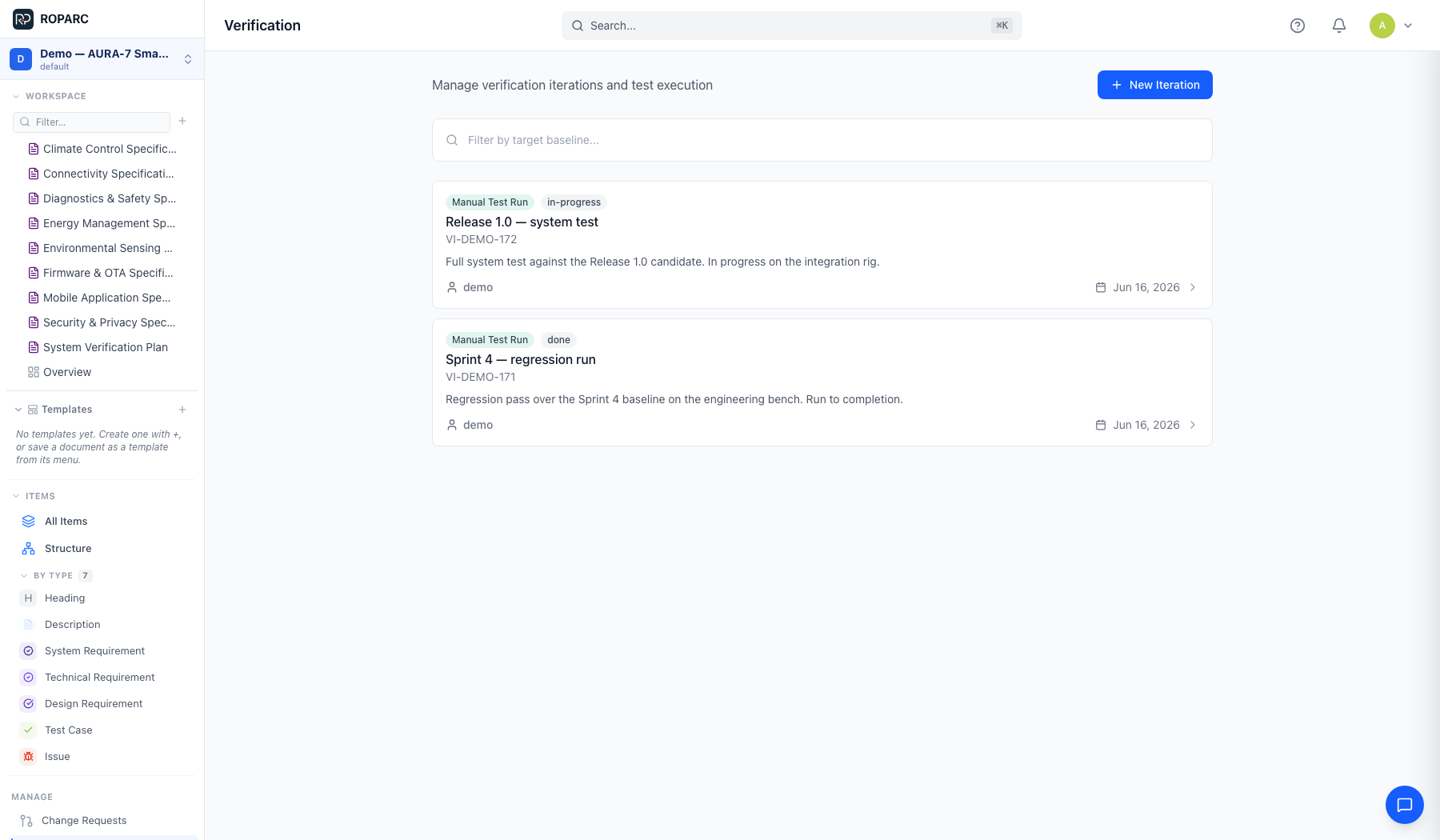
The Verification page listing a Release 1.0 system test in progress and a completed Sprint 4 regression run.
04 · Verify

Know what is verified, and what is not.

Link test cases to requirements, plan iterations against a baseline, execute step by step and record verdicts, or import the results from your automation. When a requirement changes after its test passed, the link turns suspect and the coverage view shows the gap.

  • Requirement to test case to recorded evidence
  • Manual execution and automated result import
  • Suspect links and coverage reporting
Learn more
A document in compare mode with track-changes redlines, inserted text highlighted and removed text struck through.
05 · Prove

Walk into the audit ready.

Cut a baseline and it stays exactly as it was, configuration included, for as long as the product lives. Compare any two revisions as track-changes redlines. Close a review and ROPARC writes the protocol. The audit log and integrity scan show that what the application did matches what the repository contains.

  • Immutable baselines and curated releases
  • Track-changes comparison of any two revisions
  • Generated review protocols, audit log, integrity scan
Learn more

Why the evidence holds up

It is Git underneath.

Most ALM tools bolt history and audit onto a database. ROPARC stores every requirement, document, link, review and baseline as a commit in a real Git repository. The audit trail is the storage, not a feature.

Every change is a commit

History is complete and attributable. Nothing is silently overwritten or lost.

History is content-addressed

Tamper-evident by construction, not a log you are asked to trust.

The database is a rebuildable index

A corrupt database is an inconvenience, not an incident.

Follow one change from proposal to audit

Built for teams that have to prove it

Regulated product development, where the tool has to satisfy the assessor as well as the engineer.

Automotive and industrial

ISO 26262 · ASPICE · IEC 61508 · EN 50128

Supplier and OEM teams that need assessable traceability from system requirement to test evidence, usually arriving from DOORS, Polarion, or Word and Excel.

Medical devices

IEC 62304 · ISO 14971 · ISO 13485

Design history, risk traceability and a verifiable record of every review, in a tool a small regulatory team can run without a services contract.

Defense and public sector

On-prem · Plain files · No third party in the loop

Runs on your own servers. Your data is a Git repository you can read without us, and a full export is a copy of it, not a support ticket.

Coming from DOORS, Polarion, Jama or spreadsheets? ROPARC speaks ReqIF and Excel, and your data stays plain files you can leave with. How migration works

Try it on your own requirements

Talk to us about a dedicated or on-prem deployment, or bring real requirements into the public SaaS beta and see the traceability for yourself.